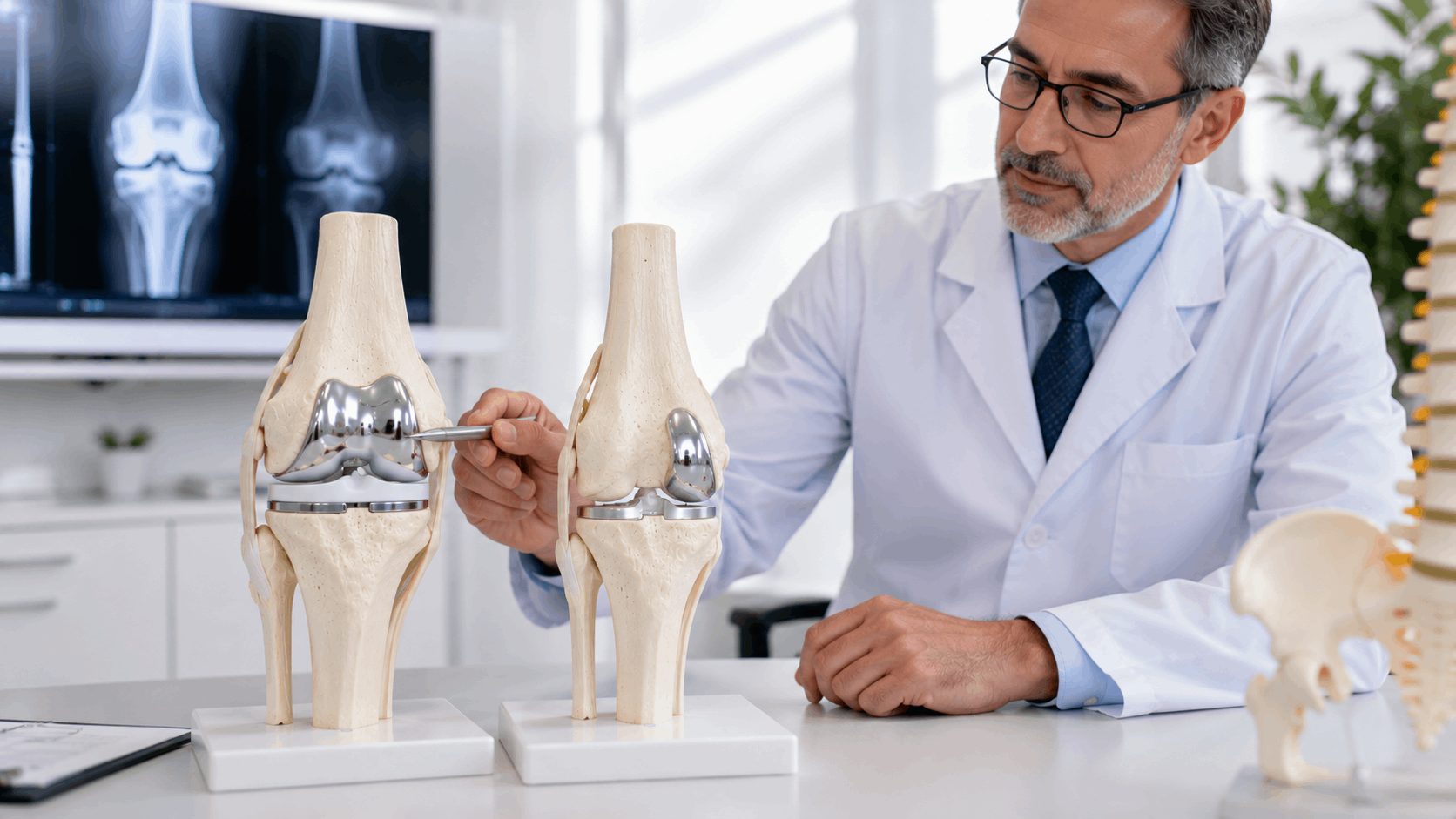
Knee pain caused by arthritis or joint damage can make everyday activities challenging. Walking, climbing stairs, standing for long periods, and even getting a good night's sleep may become difficult as the condition progresses. While medications, physiotherapy, and lifestyle changes often provide relief during the early stages, advanced joint damage may eventually require surgical treatment.
One of the most common questions patients ask is whether they need a Total Knee Replacement or a Partial Knee Replacement. Although both procedures aim to relieve pain and restore mobility, they are recommended for different conditions and patients. Choosing the right option depends on the extent of joint damage, the location of arthritis, age, activity level, and overall health.
Understanding the differences between these procedures can help you make informed decisions about your treatment. Dr. Praveen Reddy provides comprehensive orthopedic evaluation and personalized treatment plans to determine the most suitable surgical option for every patient.
Knee replacement surgery is performed when the knee joint has been severely damaged and conservative treatments no longer provide adequate relief. The procedure involves replacing damaged portions of the knee with artificial implants designed to restore smooth movement and reduce pain.
Depending on the extent of arthritis or joint damage, your orthopedic surgeon may recommend either a Total Knee Replacement or a Partial Knee Replacement.
Although both procedures share the same objective of improving mobility and relieving pain, the amount of bone and cartilage replaced differs significantly.
Total Knee Replacement Surgery, also known as Total Knee Arthroplasty, involves replacing all three major compartments of the knee joint with artificial implants. The damaged cartilage and worn-out bone surfaces are carefully removed and replaced with specially designed components made from durable medical-grade materials.
This procedure is commonly recommended for patients with advanced osteoarthritis affecting multiple areas of the knee. It is also suitable for patients with severe joint deformity, rheumatoid arthritis, or extensive cartilage damage.
The primary goal of Total Knee Replacement is to eliminate chronic pain, improve joint stability, and restore long-term function.
Partial Knee Replacement, sometimes called Unicompartmental Knee Replacement, is a less extensive procedure that replaces only the damaged portion of the knee while preserving the healthy cartilage, ligaments, and bone in the unaffected compartments.
This option is generally suitable for patients whose arthritis is limited to one specific section of the knee. Because more of the natural knee is preserved, some patients experience a more natural-feeling joint after recovery.
However, Partial Knee Replacement is appropriate only for carefully selected patients after thorough orthopedic evaluation.
The biggest difference lies in the amount of the knee joint being replaced.
In a Total Knee Replacement, the entire knee joint is resurfaced because arthritis or damage affects multiple compartments. In a Partial Knee Replacement, only the diseased compartment is treated while the healthy portions of the knee remain intact.
The choice between these procedures depends on imaging findings, physical examination, ligament stability, and the overall condition of the knee joint rather than patient preference alone.
Patients are generally considered suitable candidates for Total Knee Replacement when arthritis has become widespread throughout the knee joint and significantly affects quality of life.
Your orthopedic surgeon may recommend Total Knee Replacement if you experience:
This procedure offers long-term pain relief for patients with advanced knee disease.
Partial Knee Replacement is usually considered when arthritis is limited to a single compartment of the knee and the remaining joint structures remain healthy.
Patients who may benefit include those with:
A detailed orthopedic evaluation is essential to determine whether Partial Knee Replacement is appropriate.
Total Knee Replacement remains one of the most successful orthopedic procedures performed worldwide. It provides predictable long-term results for patients with severe arthritis.
Common benefits include:
Many patients return to normal daily activities after rehabilitation with much greater comfort than before surgery.
For appropriately selected patients, Partial Knee Replacement offers several advantages because less of the natural knee is replaced.
Potential benefits include:
However, these advantages apply only when the patient's arthritis is truly limited to one part of the knee.
Recovery following either procedure depends on the patient's age, health, muscle strength, and commitment to physiotherapy.
Most patients begin walking with assistance within the first day after surgery. Rehabilitation focuses on improving knee movement, strengthening muscles, and restoring confidence during walking.
Patients undergoing Partial Knee Replacement may experience slightly faster early recovery because less tissue is involved. However, long-term success depends on following the rehabilitation program carefully regardless of the type of surgery performed.
Many patients ask whether Total Knee Replacement or Partial Knee Replacement is the better option.
The answer depends entirely on the condition of the knee.
If arthritis affects the entire joint, Total Knee Replacement usually provides the best long-term outcome. If damage is confined to one compartment and the remaining structures are healthy, Partial Knee Replacement may be an excellent choice.
The decision should always be based on a thorough orthopedic assessment rather than personal preference alone.
Choosing an experienced orthopedic surgeon is one of the most important factors in achieving successful treatment and recovery.
Dr. Praveen Reddy provides comprehensive orthopedic evaluation using advanced diagnostic techniques to determine the most appropriate treatment for each patient. Every surgical plan is individualized based on the patient's symptoms, imaging findings, lifestyle, activity level, and long-term goals.
His expertise includes Total Knee Replacement Surgery, Partial Knee Replacement, arthroscopy, sports injury treatment, fracture management, trauma care, and comprehensive orthopedic services.
Patients may also explore Total Knee Replacement Surgery, Walking After Knee Replacement Surgery and Orthopedic Services to better understand their treatment options.
Which lasts longer, Total Knee Replacement or Partial Knee Replacement?
Total Knee Replacement generally offers excellent long-term durability because the entire joint is replaced. Partial Knee Replacement also provides good long-term results in carefully selected patients.
Is recovery faster after Partial Knee Replacement?
Many patients experience a quicker early recovery because less bone and soft tissue are involved. However, individual recovery varies.
Can a Partial Knee Replacement later become a Total Knee Replacement?
Yes. If arthritis develops in other compartments of the knee over time, revision to a Total Knee Replacement may become necessary.
Is Partial Knee Replacement suitable for everyone?
No. It is recommended only for patients with arthritis limited to one compartment and healthy surrounding joint structures.
How do I know which surgery is right for me?
A comprehensive orthopedic evaluation, including physical examination and imaging studies, will help determine the most appropriate procedure for your condition.
Both Total Knee Replacement and Partial Knee Replacement are highly effective procedures for relieving chronic knee pain and restoring mobility. The right choice depends on the extent of arthritis, overall knee health, and individual patient needs.
A detailed orthopedic assessment is the key to selecting the most suitable treatment and achieving the best possible long-term outcome.
If you are experiencing persistent knee pain and would like to understand which knee replacement procedure is right for you, consult Dr. Praveen Reddy for expert evaluation, personalized treatment planning, and advanced orthopedic care.