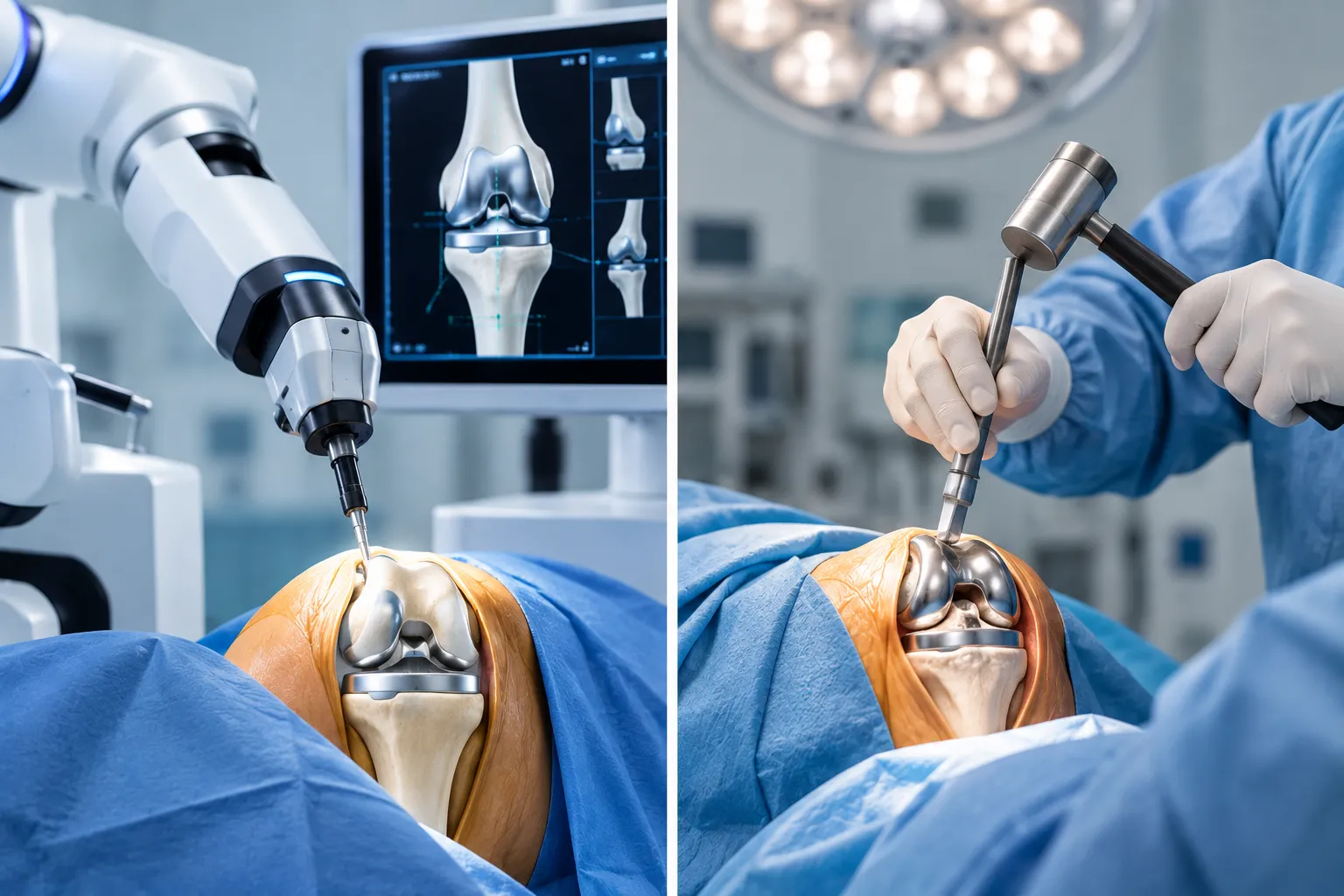
Knee replacement surgery has changed significantly with advances in surgical technology. Today, patients with severe knee arthritis may be offered either conventional knee replacement or robotic-assisted knee replacement. Both procedures are designed to relieve pain, improve knee function, and help patients return to daily activities.
The main difference is not the replacement implant itself but how the surgery is planned and performed. Robotic-assisted knee replacement uses advanced computer technology and a robotic system to help the surgeon plan bone cuts, position the implant, and balance the knee. Conventional knee replacement relies more on standard surgical instruments and guides.
This can make robotic surgery sound very different from traditional knee replacement. However, patients should understand that the surgeon remains in control of the procedure, and robotic technology is an additional surgical tool rather than an independent operating system.
So, what really changes for patients? Does robotic surgery mean less pain, faster recovery, or a longer-lasting implant? And is it worth considering over conventional knee replacement?
Let's look at the differences in simple terms.
Conventional, or traditional, total knee replacement is a well-established procedure used to treat advanced knee arthritis and other conditions that have severely damaged the knee joint.
During surgery, the damaged surfaces of the thigh bone and shin bone are removed using standard surgical instruments and alignment guides. The surgeon carefully positions the artificial components to restore knee alignment, stability, and movement.
Conventional knee replacement has been performed successfully for many years and remains an effective treatment for patients with severe knee damage.
The success of the surgery depends on several factors, including accurate implant positioning, appropriate implant selection, soft-tissue balancing, the surgeon's experience, the patient's overall health, and commitment to rehabilitation.
Robotic knee replacement uses computer-assisted technology to help the surgeon plan and perform the operation.
Before surgery, the patient's knee anatomy is assessed using appropriate imaging and digital planning. During the procedure, the robotic system helps the surgeon understand the patient's individual anatomy and provides guidance for making precise bone cuts and positioning the implant.
The robot does not replace the surgeon. The surgeon controls the instruments and makes the important decisions throughout the operation.
One potential advantage is that robotic technology can help the surgeon execute the preoperative plan with a high level of precision. Studies have found that robotic systems can improve the accuracy of component positioning, although improved accuracy does not automatically mean better long-term clinical outcomes for every patient.
The biggest differences are related to planning, surgical guidance, and precision.
With conventional knee replacement, the surgeon uses standard instruments and mechanical alignment guides to determine where bone should be removed and how the implants should be positioned.
With robotic-assisted surgery, computer technology creates a more detailed surgical plan based on the patient's anatomy. The robotic system then helps guide the surgeon during the bone preparation and implant positioning.
In both procedures, however, the surgeon is responsible for evaluating the knee, selecting the appropriate implant, managing the soft tissues, and making final surgical decisions.
One of the strongest arguments for robotic-assisted surgery is its ability to help with precision.
The technology can provide detailed information about the patient's knee anatomy and help the surgeon make planned bone cuts and position components accurately. This may be particularly useful when a patient's anatomy is complex or when very precise alignment and balancing are required.
However, accuracy should not be confused with guaranteed better results.
The American Academy of Orthopaedic Surgeons notes that evidence has not shown a significant short-term difference in function, overall outcomes, or complications between robotic-assisted and conventional total knee replacement.
This means robotic technology is a useful tool, but it is not automatically better for every patient.
Pain after knee replacement depends on many factors, including the surgical technique, pain-management plan, individual pain sensitivity, rehabilitation, and overall health.
Some studies have reported less pain or improved early recovery with robotic-assisted knee replacement. For example, recent AAOS-reviewed research reported reduced early postoperative pain and improved early knee flexion in a robotic-assisted group, although differences in longer-term clinical outcomes were not significant.
Therefore, patients should not expect robotic surgery to completely eliminate postoperative pain.
The goal of robotic technology is primarily to assist the surgeon with planning and precision. Pain management and rehabilitation remain important parts of recovery regardless of which surgical technique is used.
Some patients may experience a smooth and relatively quick recovery after robotic-assisted knee replacement. Certain studies have reported advantages in early function, hospital stay, or discharge to home.
However, recovery is highly individual.
Your age, muscle strength, weight, medical conditions, severity of arthritis, preoperative mobility, surgical complexity, pain control, and participation in physiotherapy can all influence recovery.
Robotic surgery should therefore not be viewed as a guarantee of faster recovery.
A well-planned conventional knee replacement can also provide excellent pain relief and functional improvement.
Robotic technology does not necessarily mean a smaller incision.
The size of the incision depends on factors such as the surgical approach, patient's anatomy, surgeon's technique, and complexity of the procedure.
Robotic assistance is mainly related to surgical planning and execution, rather than simply making the skin incision smaller.
Patients should be cautious of claims suggesting that robotic surgery automatically means a scar-free or minimally invasive knee replacement.
Not necessarily.
Robotic-assisted and conventional knee replacement can use similar types of knee implants. The major difference is generally the technology used to plan and execute the surgery.
The choice of implant depends on factors such as the patient's anatomy, bone quality, ligament stability, activity level, and surgeon's assessment.
The implant itself is only one part of a successful knee replacement. Proper positioning, balancing, fixation, rehabilitation, and long-term patient care also matter.
Both robotic-assisted and conventional knee replacement are established surgical approaches.
Robotic technology may provide additional information and control during certain parts of the operation, but it does not eliminate the normal risks associated with knee replacement.
Possible complications can include infection, blood clots, stiffness, bleeding, nerve or blood-vessel injury, implant loosening, instability, persistent pain, and the possibility of revision surgery.
The AAOS evidence review does not show a significant short-term difference in complications between robotic-assisted and conventional total knee replacement.
The safety of surgery depends on much more than whether a robot is used. Patient selection, surgical planning, surgeon experience, infection prevention, anesthesia, pain management, and rehabilitation all play important roles.
Robotic knee replacement may cost more than conventional surgery because it can involve advanced technology, specialized equipment, additional planning, and higher facility-related expenses.
The exact cost varies between hospitals and depends on the implant, investigations, hospital stay, surgeon's fees, rehabilitation, and other aspects of treatment.
A higher price does not automatically mean a better outcome.
Patients should discuss the expected benefits, additional costs, and whether robotic assistance is appropriate for their particular knee condition before making a decision.
This is one of the most common questions patients ask.
The theory is that more accurate implant positioning could potentially contribute to better long-term performance. However, current evidence does not establish that robotic assistance automatically makes knee replacements last longer.
An American Joint Replacement Registry analysis published through the AAOS Registry Program found that navigated and robotic total knee replacement did not show improved five-year implant survivorship compared with conventional total knee replacement.
Therefore, patients should not choose robotic surgery solely because they believe it guarantees a longer-lasting implant.
Long-term implant performance depends on several factors, including implant design, fixation, positioning, patient activity, body weight, bone quality, and other individual factors.
Robotic-assisted knee replacement may be considered for patients who require knee replacement and may benefit from detailed computer-assisted planning and precise execution.
It can be particularly useful when the surgeon wants additional information about individual knee anatomy, alignment, and soft-tissue balance.
However, not every patient needs robotic assistance.
A skilled orthopedic surgeon will assess the severity of arthritis, deformity, ligament condition, bone quality, previous surgeries, overall health, activity requirements, and other factors before recommending the most appropriate approach.
Conventional knee replacement remains an excellent option for many patients.
It has a long history of successful use and does not mean that the surgery is outdated or less effective. Experienced surgeons can achieve excellent implant positioning and functional results using conventional techniques.
For many patients, the difference between the two approaches may be smaller than expected.
The most important question is not simply, "Is robotic surgery better?"
It is:
"Which surgical approach is most appropriate for my knee and my individual needs?"
Patients sometimes focus heavily on whether a hospital offers robotic knee replacement. While technology can be valuable, several other factors are equally important.
The surgeon's experience with knee replacement, careful preoperative assessment, appropriate implant selection, accurate surgical technique, infection prevention, pain management, and structured physiotherapy can all influence the outcome.
A robotic system is a tool that supports the surgeon. It does not replace surgical judgment or patient-specific decision-making.
If you are considering knee replacement, ask your orthopedic surgeon why a particular technique is being recommended for you.
Useful questions include:
These questions can help you make a decision based on your individual condition rather than marketing claims.
No two knees are exactly the same. Patients can have different levels of cartilage damage, bone loss, deformity, ligament stability, muscle strength, and mobility.
For this reason, knee replacement should be planned around the patient rather than around the technology.
Robotic assistance can provide additional planning and surgical guidance, while conventional techniques remain highly effective when performed appropriately. The right approach depends on the patient's anatomy, condition, expectations, and the surgeon's clinical judgment.
The difference between robotic knee replacement and conventional knee replacement is mainly the technology used to plan and assist the surgery.
Robotic systems can help surgeons with detailed planning, alignment, bone preparation, and implant positioning. Some research suggests potential benefits in early pain or functional recovery, but current evidence does not show that robotic knee replacement is universally superior to conventional surgery in terms of short-term function, complications, or long-term implant survival.
For patients, the most important decision is not simply choosing a robotic or conventional procedure. It is choosing an appropriate treatment plan based on the condition of the knee, overall health, expectations, and the expertise of the orthopedic surgeon.
If severe knee pain, stiffness, or difficulty walking is affecting your daily life, an orthopedic evaluation can help determine whether knee replacement is appropriate and which surgical approach may be best for you.
Is robotic knee replacement better than conventional knee replacement?
Robotic knee replacement offers additional computer-assisted planning and surgical guidance, but current evidence does not establish that it is universally better than conventional knee replacement. The best approach depends on the individual patient and the surgeon's assessment.
Is robotic knee replacement less painful?
Some studies have reported less pain during the early recovery period with robotic-assisted surgery, but postoperative pain varies between patients. Pain-management strategies and rehabilitation remain important regardless of the technique used.
Does robotic knee replacement have a faster recovery?
Some patients may experience improved early functional recovery, but robotic surgery does not guarantee a faster recovery. Individual health, muscle strength, rehabilitation, and surgical complexity also influence recovery.
Does robotic knee replacement last longer?
Robotic technology may improve the accuracy of implant positioning, but there is currently no clear evidence that robotic assistance automatically results in longer implant survival.
Is conventional knee replacement still a good option?
Yes. Conventional knee replacement is a well-established procedure with proven outcomes and remains appropriate for many patients.
Does a robot perform the knee replacement surgery?
No. The orthopedic surgeon performs the operation. The robotic system provides computer-assisted planning and guidance during specific parts of the procedure.
How do I know which knee replacement procedure is right for me?
Your orthopedic surgeon can assess your arthritis, knee alignment, ligament stability, bone quality, medical condition, activity level, and expectations before recommending the most appropriate surgical approach.