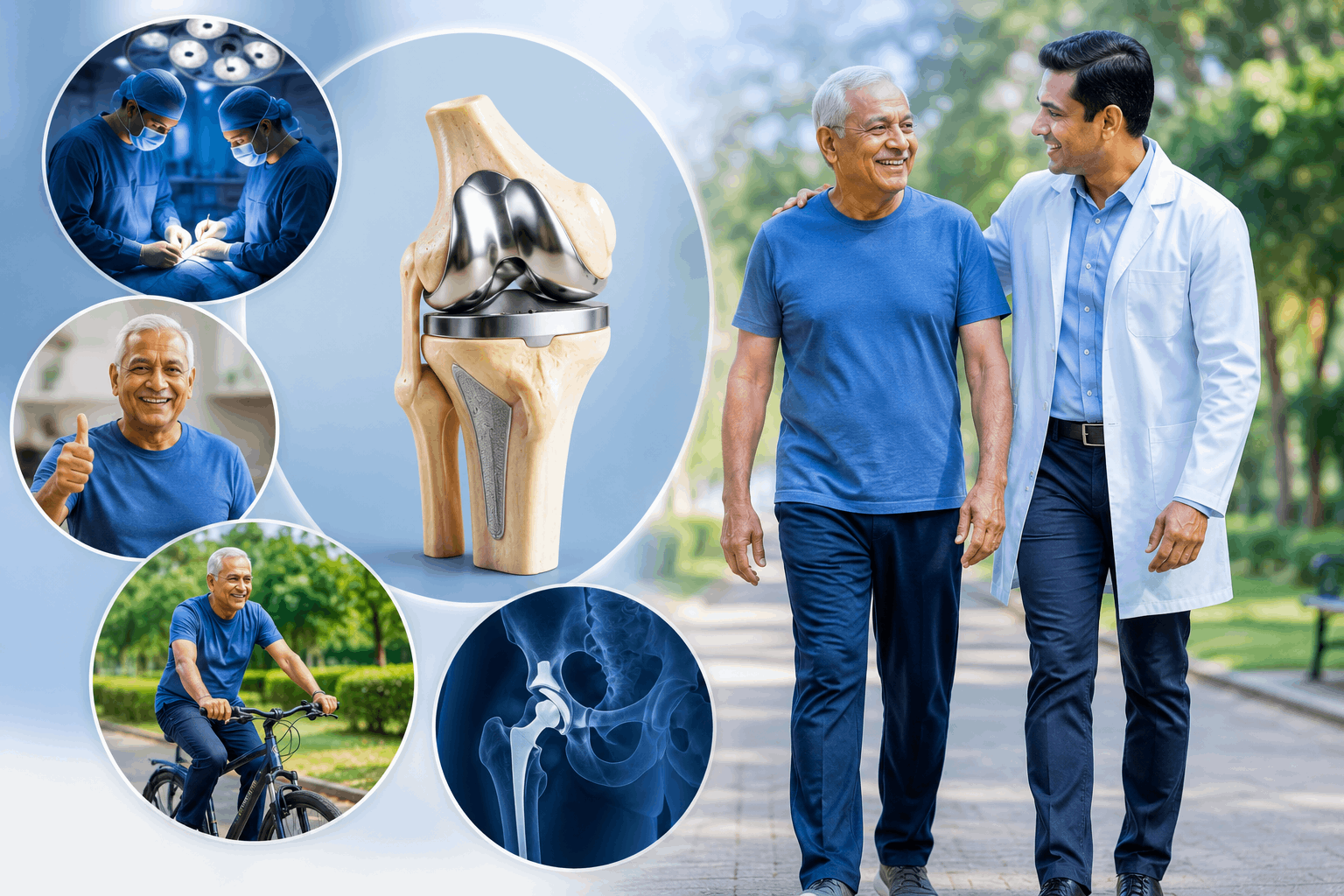
Persistent joint pain can gradually affect almost every aspect of daily life. Walking, climbing stairs, standing for long periods, exercising, working, and even sleeping can become difficult when arthritis or severe joint damage progresses. Although medications, physiotherapy, lifestyle changes, and other non-surgical treatments can provide relief, they may become less effective when the joint has undergone advanced damage.
Modern Joint Replacement Surgery has transformed the treatment of severe arthritis and joint degeneration. Advances in implant materials, surgical planning, anesthesia, pain management, and rehabilitation have made joint replacement more precise, safer, and more focused on helping patients return to an active lifestyle.
For appropriately selected patients, replacing a damaged joint can provide significant pain relief, improve mobility, and restore independence. Dr. Praveen Reddy provides comprehensive orthopedic care and personalized treatment plans for patients considering knee, hip, and other joint replacement procedures.
Joint Replacement Surgery involves removing damaged portions of a joint and replacing them with artificial components designed to restore smooth movement and joint stability.
The procedure is most commonly performed on the knee and hip. In a Total Knee Replacement, damaged surfaces of the knee are replaced with prosthetic components. During Total Hip Replacement Surgery, the damaged ball and socket of the hip are replaced with artificial components.
Modern joint replacement focuses not only on replacing damaged bone and cartilage but also on restoring alignment, balance, movement, and function according to each patient's anatomy.
Orthopedic surgery has advanced significantly over the years. Modern imaging, computer-assisted planning, improved implant designs, minimally invasive approaches where appropriate, and better rehabilitation protocols have all contributed to improved patient outcomes.
Surgeons can now plan procedures more carefully, select implants based on individual anatomy, and use advanced techniques to achieve accurate positioning.
Improved anesthesia and pain-management strategies also allow many patients to begin moving soon after surgery, supporting earlier rehabilitation and recovery.
One of the primary benefits of modern joint replacement is relief from chronic joint pain.
Severe arthritis can cause pain during walking, climbing stairs, standing, or even resting. As cartilage wears away, bones can rub against each other, creating persistent discomfort and inflammation.
Joint replacement removes the severely damaged joint surfaces and replaces them with artificial components designed to allow smoother movement. For many appropriately selected patients, this can result in a substantial reduction in the pain caused by advanced arthritis.
Joint damage can significantly restrict movement. Patients may find it difficult to bend their knee, rotate their hip, walk longer distances, or perform routine activities.
After joint replacement and rehabilitation, many patients experience improved range of motion and greater confidence while moving. The improvement allows them to gradually return to activities that had become difficult because of pain and stiffness.
Physiotherapy plays an important role in helping patients regain strength and flexibility after surgery.
Severe joint pain can make patients dependent on family members for everyday activities. Getting dressed, bathing, shopping, cooking, climbing stairs, or moving around the house may become challenging.
Successful joint replacement can help restore independence by making these activities easier and more comfortable.
For many patients, the ability to perform daily tasks without relying heavily on others is one of the most meaningful benefits of treatment.
Modern joint replacement programs emphasize early movement rather than prolonged bed rest.
When medically appropriate, patients are encouraged to stand and walk with assistance soon after surgery. Early mobilization can improve circulation, reduce stiffness, support muscle activation, and help patients regain confidence.
The exact timing depends on the type of surgery and the patient's medical condition, but early rehabilitation has become an important part of modern orthopedic care.
Modern artificial joints are manufactured using advanced medical-grade materials designed to withstand years of everyday movement.
Improved implant designs and bearing surfaces have contributed to better long-term durability. Many modern knee and hip replacement implants can function effectively for 15 to 20 years or longer, although implant lifespan varies from patient to patient.
Factors such as age, body weight, activity level, implant design, surgical technique, and overall health can influence long-term implant performance.
Modern joint replacement is increasingly focused on individualized treatment rather than a one-size-fits-all approach.
Before surgery, the orthopedic surgeon evaluates the patient's joint anatomy, alignment, bone quality, symptoms, activity level, and overall health. Imaging studies help with surgical planning and implant selection.
In selected cases, computer-assisted or robotic technology may be used to support surgical planning and implant positioning.
The objective is to create a stable and functional artificial joint that matches the patient's individual anatomy as closely as possible.
Recovery after joint replacement is supported by structured rehabilitation programs designed around the patient's needs.
Physiotherapy may begin soon after surgery and focuses on improving joint movement, strengthening surrounding muscles, restoring balance, and gradually increasing walking ability.
Patients are guided through different stages of recovery rather than being expected to return immediately to normal activities.
Consistent participation in rehabilitation can help patients achieve better functional outcomes and regain confidence in their new joint.
The benefits of joint replacement extend beyond the joint itself. Chronic pain can affect sleep, mood, social activities, physical fitness, and overall confidence.
When pain decreases and mobility improves, patients may become more active and participate in activities they previously avoided.
Many patients find that they can spend more time with family, travel more comfortably, exercise appropriately, and enjoy everyday life with fewer physical limitations.
Patients with advanced arthritis may rely on pain-relieving medications to manage daily symptoms. While medications can be useful, long-term use may not be appropriate for everyone and should always be managed under medical supervision.
When joint replacement successfully addresses the underlying mechanical damage, many patients experience significantly less pain and may no longer require the same level of pain medication.
Medication should never be stopped suddenly without consulting the treating doctor.
Once adequate healing has occurred and the orthopedic surgeon provides clearance, many patients can return to low-impact activities.
These may include walking, swimming, cycling, selected strengthening exercises, and other joint-friendly activities.
Staying physically active after recovery can help maintain muscle strength, balance, cardiovascular health, and overall fitness. High-impact activities may not be appropriate for every patient and should be discussed with the orthopedic surgeon.
Joint replacement is generally considered for patients with significant joint damage who continue to experience pain and functional limitations despite appropriate non-surgical treatment.
Potential candidates may have advanced osteoarthritis, rheumatoid arthritis, severe post-traumatic joint damage, avascular necrosis, or other conditions causing significant joint destruction.
However, not everyone with arthritis requires surgery. A detailed orthopedic assessment is necessary to determine whether joint replacement is appropriate.
Choosing an experienced orthopedic surgeon is an important part of achieving a successful outcome. Dr. Praveen Reddy provides comprehensive orthopedic care with an emphasis on accurate diagnosis, personalized treatment planning, and modern surgical techniques.
Each patient is evaluated based on their symptoms, imaging findings, medical history, lifestyle, and long-term mobility goals. Conservative treatments are considered whenever appropriate before surgery is recommended.
His areas of expertise include knee replacement, hip replacement, arthroscopy, sports injury treatment, fracture management, trauma care, and comprehensive Orthopedic Services.
Patients considering treatment can also explore Total Knee Replacement Surgery and Total Hip Replacement Surgery to understand the available surgical options.
What are the main benefits of modern joint replacement surgery?
The major benefits include significant pain relief, improved mobility, greater independence, better joint function, improved quality of life, and the ability to return to many everyday and low-impact activities.
Is joint replacement surgery safe?
Joint replacement is generally considered a safe and effective procedure for appropriately selected patients. Like any major surgery, it carries potential risks, which should be discussed with your orthopedic surgeon.
How long do modern joint replacement implants last?
Many modern knee and hip implants provide 15 to 20 years or longer of reliable function. Longevity depends on factors such as age, activity level, body weight, implant type, and overall health.
How soon can I walk after joint replacement surgery?
Many patients begin standing and walking with assistance soon after surgery when medically appropriate. The exact timing depends on the joint replaced and individual health.
Can I exercise after joint replacement surgery?
Yes. After adequate healing and medical clearance, low-impact activities such as walking, swimming, and cycling are generally encouraged. High-impact activities may need to be limited.
Modern Joint Replacement Surgery has changed the way severe joint arthritis and degeneration are treated. Advances in implant technology, surgical planning, anesthesia, pain management, and rehabilitation allow appropriately selected patients to achieve significant improvements in pain, mobility, independence, and quality of life.
The decision to undergo surgery should always be individualized. If joint pain is limiting your daily activities and conservative treatments are no longer providing sufficient relief, an orthopedic evaluation can help determine whether joint replacement is the right option.
Dr. Praveen Reddy provides personalized orthopedic evaluation and advanced joint replacement care to help patients move with greater comfort and confidence. If persistent knee or hip pain is affecting your quality of life, consult an orthopedic specialist to understand your treatment options and take the next step toward improved mobility.